

Vertical SaaS 2.0: A Deep Niche Defensibility


The era of the “AI wrapper” is experiencing rapid entropy. We are witnessing the collapse of the generic; a structural failure inevitable from the moment the cost of intelligence approached zero.
For the last twenty-four months, the market has been flooded with horizontal AI: thin veneers over large language models, offering general-purpose text generation or basic summarization. These are systems with high velocity but zero mass. They have no friction, no gravity, and consequently, no defensibility. In physics, if you have no mass, you are easily displaced. In business, if your product is a generic interface for a commodity model, you are not building a company; you are leasing a feature that Microsoft or Google will eventually distribute for free.
The capital and the value are migrating. We are moving from the expansive, shallow ocean of Horizontal AI to the high-pressure, structural depths of Vertical SaaS 2.0. This is the shift from “tools for everyone” to “systems for the few.”
This is the Deep Niche Engine.
The Collapse of the Horizontal Surface
To understand why Vertical SaaS 2.0 is the only load-bearing architecture left, we must first dissect the structural weakness of Horizontal AI.
Horizontal tools—generic writing assistants, broad-spectrum image generators, generalized coding copilots—suffer from a lack of context. They operate on the open web’s data, which is effectively public domain. When everyone has access to the same foundation models and the same training data, the only differentiator is the User Interface (UI).
UI is not a moat. It is paint.
A generic AI tool is like a dictionary. It contains all the words, but it knows nothing of the specific legal precedent required to defend a patent in the Southern District of New York. It knows the syntax of Python, but it knows nothing of the spaghetti-code legacy architecture of a specific mid-sized logistics firm in Ohio.
Without context, intelligence is hallucination. Horizontal AI guesses. In high-stakes industries, guessing is not a feature; it is a liability.
The market is realizing that “intelligence” is a commodity. “Correctness” is the asset. And correctness only exists within the Deep Niche.
The Architecture of the Deep Niche
Vertical SaaS 2.0 is not about taking a generic tool and narrowing the marketing. It is about architectural specificity. It is the difference between a general contractor who builds strip malls and a naval architect who designs nuclear submarines. Both use steel; only one understands the crushing pressure of the deep.
The Deep Niche Engine is defined by its ability to solve high-frequency, high-value problems that are invisible to the general public. These are not problems of creativity; they are problems of compliance, entropy, and catastrophic failure.
Consider the distinction:
Horizontal AI: Helps you write an email faster. Value: Low. Risk of failure: Negligible.
Vertical AI-Native System: Predicts a thermal runaway event in a lithium-ion battery manufacturing line based on proprietary sensor telemetry. Value: $100k/hour in saved downtime. Risk of failure: Catastrophic.
The latter is a load-bearing asset. It supports the weight of the business. If the writing assistant goes down, you are annoyed. If the predictive maintenance system goes down, the factory stops.
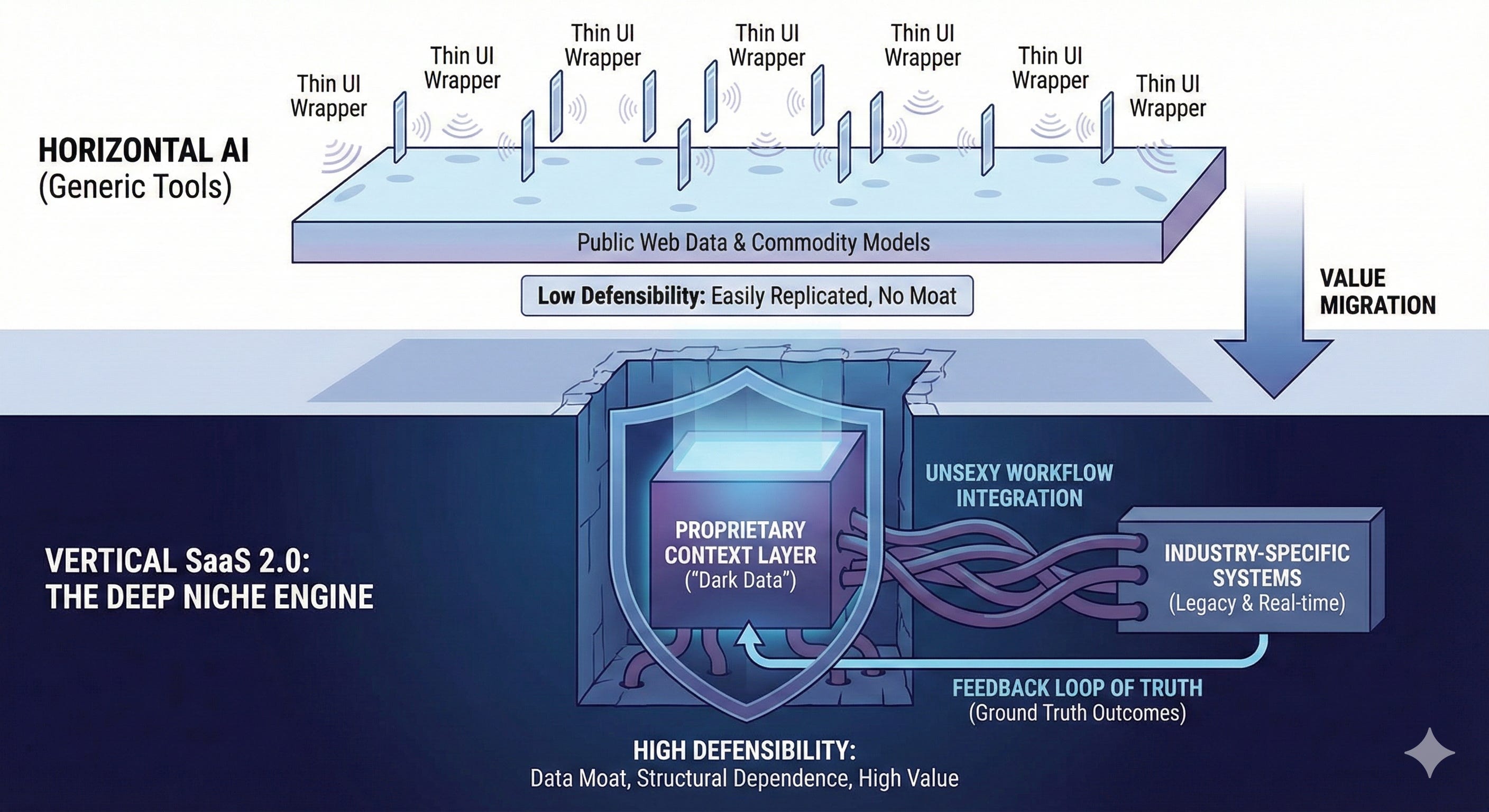
The Deep Niche Engine is built on three structural pillars: The Proprietary Context Layer, The Unsexy Workflow Integration, and The Feedback Loop of Truth.
Pillar I: The Proprietary Context Layer
The open web is tapped out. The Large Language Models (LLMs) have consumed Wikipedia, GitHub, and Reddit. That data is now air—abundant and free.
The next trillion dollars of value lies in “Dark Data.” This is data that does not exist on the open web. It is siloed inside corporate intranets, locked in PDF invoices from 1998, buried in manufacturing logs, or hidden in the unspoken heuristics of a senior underwriter.
Vertical SaaS 2.0 is an extraction engine for this Dark Data.
A true Vertical System does not just “wrap” an LLM. It injects an immense, proprietary context layer between the user and the model. This layer is the lens through which the raw intelligence of the model is focused into precision.
For example, a Vertical AI for commercial insurance does not just ask GPT-4 to “assess risk.” That is useless. Instead, it feeds the model:
Ten years of specific claims history for this specific client type.
Real-time geospatial data regarding flood zones.
The specific regulatory compliance framework of that jurisdiction.
This Context Layer is the moat. You cannot replicate it by scraping the web. You can only build it by being in the trenches, integrating with legacy systems, and earning the trust to access the data that no one else can see.
Pillar II: The “Unsexy” Workflow Integration
There is a vanity metric in Silicon Valley called “Time on Site.” In the Deep Niche, we reject this. We do not want the user to spend time on our software. We want the software to disappear.
Systems over heroics. The goal is not to give the user a superpower; it is to automate the user out of the loop.
Horizontal AI requires a “Human in the Loop” because it hallucinates. It requires prompting. It requires a hero to guide it.
Vertical SaaS 2.0 strives for “Human on the Loop” or “Human out of the Loop.” This is only possible through deep workflow integration. This is the plumbing. It is unsexy. It is hard. It involves connecting to on-premise Oracle databases, parsing archaic file formats, and navigating the chaotic reality of enterprise IT.
But this friction is the defense. If it takes six months to integrate your system into a hospital’s EHR (Electronic Health Record), that is six months of friction preventing a competitor from displacing you.
A generic tool sits in a browser tab. A Vertical System sits in the API calls. A browser tab is easily closed. An integrated API is structural. It becomes part of the building.
Pillar III: The Feedback Loop of Truth
The final component of the Deep Niche Engine is the feedback loop.
In Horizontal AI, the feedback loop is weak. If you dislike a generated image, you might regenerate it, but the model rarely learns why it was wrong in a way that fundamentally alters the system for the next user.
In Vertical SaaS, the feedback is binary and grounded in reality.
Did the predictive maintenance alert prevent the failure? (Yes/No)
Did the legal contract pass the audit? (Yes/No)
Did the patient diagnosis match the outcome? (Yes/No)
This feedback provides a “Ground Truth.” This Ground Truth is fed back into the Proprietary Context Layer, refining the system’s accuracy. Over time, this creates a compounding advantage. The system does not just get bigger; it gets denser. It becomes harder to move, harder to copy, and harder to break.
The Economic Reality: Gravity Wins
We are exiting the phase of “AI Tourism”—where companies played with tools because they were novel. We are entering the phase of “AI Infrastructure.”
Infrastructure is boring. It is invisible. It is essential.
The companies that will win in this next cycle are those that ignore the noise of the latest model release. It does not matter if Gemini is slightly better than GPT-4 this week. What matters is the architecture you build around the model.
Focus on the friction. Look for the industries where the data is messy, the workflows are archaic, and the cost of failure is high. Look for the “unsexy” problems—the regulatory loops, the supply chain logistics, the compliance audits.
Build the Context Layer. Dig the moat. Integrate until you are part of the foundation.
A writing assistant is a toy. A system that prevents a $100k/hour failure is a machine.
Kill the hero. Build the machine.